Written for owners of Singapore businesses that depend on being found: shops, clinics, studios, trades and service companies. No coding, no jargon.
Key takeaways
- ChatGPT’s shortlist is tiny. In a 2026 study of more than 350,000 US business locations, it recommended 1.2% of them. Google’s map results showed 35.9%.
- Being quoted is not the same as being named. ChatGPT linked to a site in 87% of the answers it appeared in, but said the brand’s name in only 20.7%.
- Comparison pages and “best” lists get names said out loud. Explainer articles mostly get you quoted quietly.
- Your plain pages matter. Prices, who a treatment suits, what happens at the first visit, how to book. ChatGPT goes and reads these.
- What other sites say about you beats links. Across 75,000 brands, web mentions tracked visibility in Google’s AI answers about three times more closely than backlinks did.
- None of this is a technical job. It is a publishing job, done every month.
Your customers already ask ChatGPT
A year ago, asking ChatGPT for a local business was something a few early adopters did. Not any more. In BrightLocal’s 2026 survey of US adults, 45% said they now use ChatGPT or another AI tool for local business recommendations. The year before it was 6%.
Singapore is ahead of that curve, not behind it. When OpenAI opened its office here, Singapore’s Economic Development Board said Singaporeans are among the highest users of ChatGPT per person in the world. ChatGPT itself passed 900 million weekly users in February 2026.
Here is the part that should worry you. When someone asks for a clinic or a salon, ChatGPT does not show ten results. It names a few.
ChatGPT recommended 1.2% of local business locations. Google’s map results showed 35.9%.
That comes from SOCi’s 2026 study of more than 350,000 locations of US brands. On Google you can be number seven and still get a call. In a ChatGPT answer there is no number seven. You are on the short list or you are not there.
That is the unfairness we hear about most. The owner who spent years on her craft loses the booking to the business next door, which is no better but gets named first. The customer never knew there was a choice.
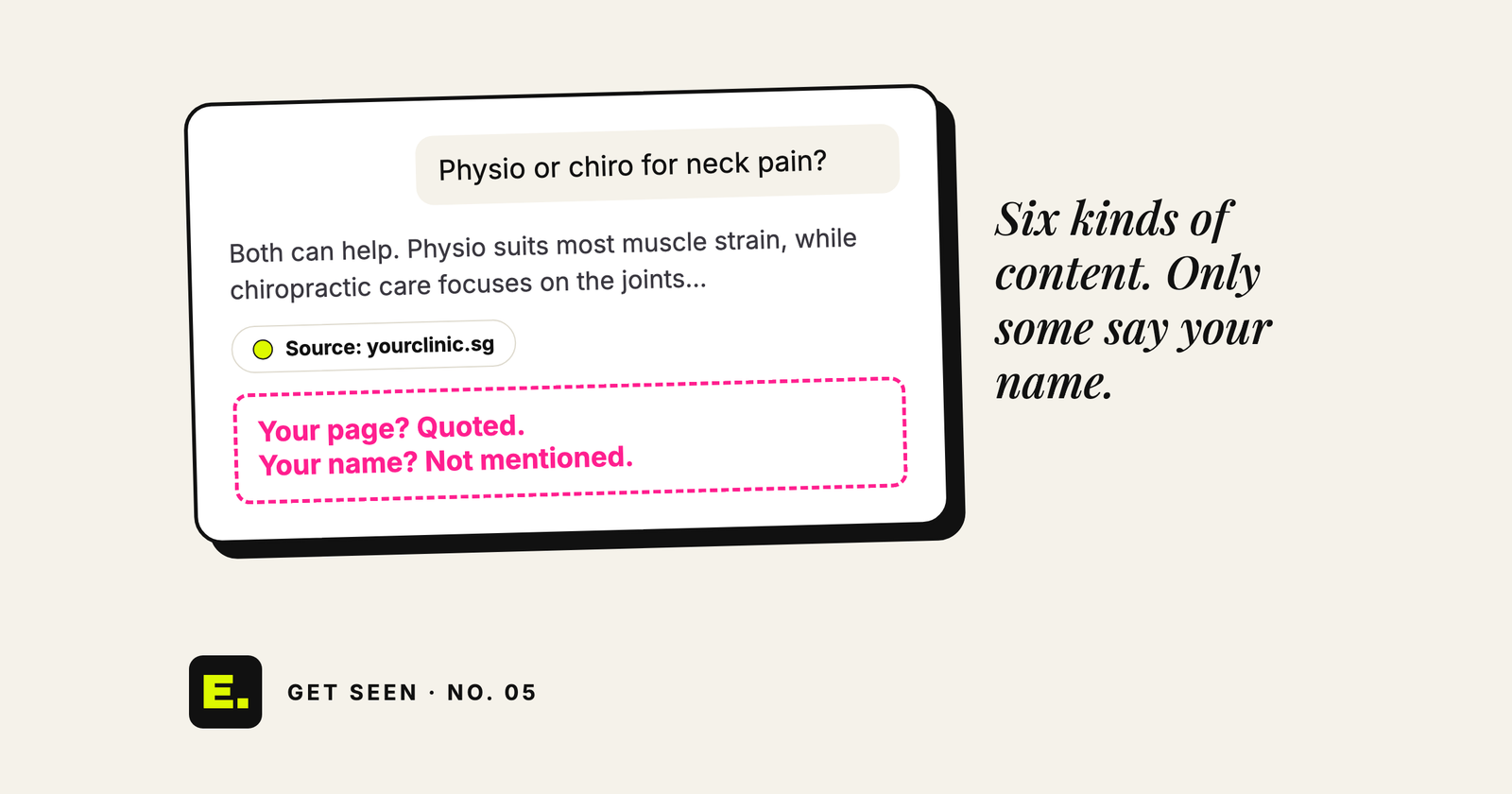
Quoted is not the same as named
Most advice on this topic says “get cited by ChatGPT”. A study published in June 2026 by Semrush and Kevin Indig shows why that is not enough.
They ran 115 questions through four AI tools in 14 countries and tracked 3,981 times a website showed up. In 61.7% of them, the AI linked to the site but never said the brand’s name in the answer. The researchers call these ghost citations. Your page did the work. Someone else got the credit, or nobody did.
The four places your business can stand
Put simply, every AI answer leaves your business in one of four spots.
| Where you stand | Your page linked? | Your name said? | What it means |
|---|---|---|---|
| Invisible | No | No | The customer never hears of you |
| Quoted, not named | Yes | No | Your words help, the customer doesn’t remember you |
| Named, not linked | No | Yes | The AI knows you from what others say |
| Named and linked | Yes | Yes | The spot that brings bookings |
Only 13.2% of appearances in the study landed in that last row. And the kind of question decided a lot. Questions that ask for information (“what causes…”) got a brand named 18% of the time. Questions that compare options got a brand named 43.3% of the time.
One more finding matters for local businesses. Short, casual questions got a brand named in nearly every answer. Long, detailed prompts got one named in 2% to 3%. Your customers don’t write essays to ChatGPT. They type “best lash salon Tampines” and hit enter.
Said plainly
Some content gets your words used. Other content gets your name said. You need both, and most businesses have neither.
The content ChatGPT reaches for
Before the formats, it helps to know what the AI weighs before it names anyone at all. ChatGPT doesn’t use one kind of page for everything. It picks the kind of page that fits the question. So the useful way to think about content is to start from what your customer types.
What ChatGPT reaches for, by the kind of question your customer asks.
| Your customer types | ChatGPT reaches for | Does it say your name? |
|---|---|---|
| “Best facial clinic in Tanjong Pagar” | “Best” lists, directories, review sites | Yes. Naming names is the whole answer. |
| “Physio or chiropractor for back pain?” | Pages that compare the options | Often. Comparisons pull names in. |
| “How much is Pico laser?” | Your own price, service and first-visit pages | Yes, if the page answers plainly |
| “Is this salon any good?” | Reviews, forums, what people say about you | Yes, for better or worse |
| “What causes neck pain after work?” | Explainer articles and guides | Rarely. You become the source, not the answer. |
Now the six kinds of content behind that table, in the order they tend to get a local business named.
1. “Best” lists and rankings
Ahrefs asked ChatGPT 750 questions that call for a recommendation, about software, products and agencies. Of the pages it used to answer, 43.8% were “best” lists. Freshness mattered too. Of 1,100 lists ChatGPT used, 79.1% had been updated in 2025.
Across a much bigger sample, Wix Studio’s 2026 review of more than a million AI citations found list articles made up 21.9% of them, ahead of articles (16.7%) and product pages (13.7%).
If you run a licensed clinic
Singapore’s healthcare advertising rules don’t allow “best”, “top” or claims that you are better than other providers in your own material, so a list that ranks your own clinic is out. Other people’s “best” lists need care too: you may not pay for a place in one, reshare it or link to it, and MOH may expect you to ask for a non-compliant one to be taken down. What works instead is a plain “how to choose” guide with honest criteria, and being listed in ordinary directories that show contact details and list everyone in order. This is not legal advice, and your own compliance check has the last word.
Directories matter more in health than anywhere else. Yext looked at 6.8 million AI citations and found that in healthcare, 52.6% came from listings and directories.
2. Pages that compare the options
“Botox or fillers?” “Physio or massage?” “Laser or peel?” “HIFU or thread lift?” Your customers ask these every week. Each one forces the AI to name treatments, and often providers. That is why comparison questions got a brand named 43.3% of the time in the Semrush study, more than twice the rate of plain information questions.
A good comparison page is fair. It says when the other option is the better choice. That is what makes the AI trust it enough to quote it.
3. Your plain pages: prices, services, first visit
This is the one most owners skip, because it doesn’t feel like “content”. It is. Discovered Labs studied 291,607 ChatGPT citations and saw it going live to businesses’ own pricing, service and about pages to check facts. In their tests, pages owned by the business made up 28% of what ChatGPT read and 36% of what it cited. Their data comes mostly from software companies, but the direction is clear.
BrightLocal found the same thing locally. In 800 local searches, 58% of ChatGPT’s sources were business websites.
So write down the answers your front desk gives on the phone. What the treatment is for. Who it doesn’t suit. What happens at the first visit. What it costs, or what sets the price. If those answers only live in your staff’s heads, ChatGPT can’t repeat them.
4. Reviews and what other people say about you
ChatGPT checks your name against what others say. In SOCi’s study, the locations ChatGPT recommended averaged 4.3 stars. Reviews won’t get you onto the list on their own, but a weak rating can keep you off it.
Mentions count too, even without a link. Ahrefs studied 75,000 brands and found that how often a brand was mentioned across the web tracked its visibility in Google’s AI answers far more closely than its backlinks did (a correlation of 0.664, against 0.218). In a later study across ChatGPT and Google’s AI, mentions on YouTube tracked most closely of all (0.737). These show a link, not proof of cause. The direction still matters.
5. Explainer guides
Guides that answer “what is” and “why does” questions get quoted a lot. They earn the citation, but the answer often leaves your name out. Write them anyway. A good guide brings people in from Google, and it gives the AI a reason to trust your comparison and service pages.
6. Your own numbers
Facts nobody else has are hard for the AI to find anywhere else, so it has to credit you. In NP Digital’s 2026 survey, 500 marketers and business owners rated original research as the content that performs best in AI search (82%), ahead of comparisons (76%). That is what marketers believe, not a count of citations. For a clinic it can be simple: the ten questions patients asked most this year, answered, with no names attached.
One more thing runs through all six: describe yourself the same way every time. What you do, and where. If your own pages, your listings and other sites each call you something different, ChatGPT can’t place you, so it names a business it is sure about.
One rule runs through all six. Updated pages beat new pages. Seer Interactive found that 72% of the pages AI tools cited had been updated in the past year. Only 42% had been published in the past year. Keeping a page up to date is enough. It doesn’t have to be brand new.
What we saw on a real clinic
We have watched this play out on Dr Neck Pain, a chiropractic clinic in Singapore. We started publishing guides for the clinic in early September 2026. Here is what we saw, with dates.
Two hours from publishing to first source
How we know
A comparison page, quoted within two hours. On 22 September 2026 we published a page comparing TENS machines with neck traction. By 6:48pm, in a private browser window, Google’s AI Overview for “TENS vs. Manual Cervical Traction” listed the page as its first source. Two minutes later it was the first normal result on Google, above the US National Institutes of Health. Look at the AI’s answer. It rebuilt the comparison table from our page.
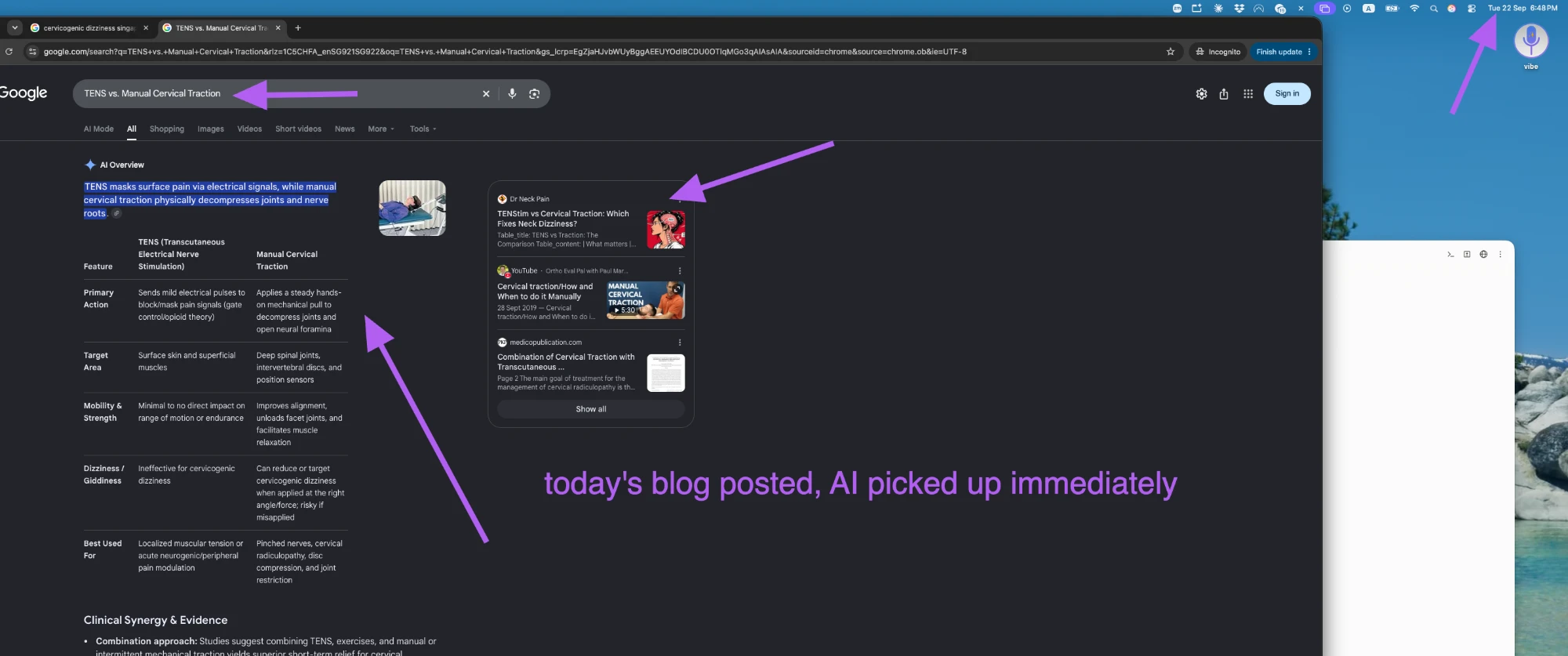
Screenshot 1. Google search, Singapore, private window, 22 September 2026, 6:48pm. The AI’s table follows the page’s own comparison table. Dr Neck Pain is the first source on the right.
But notice what the answer text doesn’t do. It never says “Dr Neck Pain”. The page was quoted. The clinic was not named. That is a ghost citation, on a page we built ourselves.
The page that got the clinic named
How we know
A “best clinics” guide, and the clinic named. On 17 September we searched “the best neck pain specialist”. Doctors and hospitals own this search. Google’s AI Overview listed Dr Neck Pain Clinic second in its top options, above a medical pain clinic and a private hospital group. The source it showed was the clinic’s own guide to the best neck pain clinics in Singapore. This time the name was in the answer. (Chiropractors in Singapore don’t fall under the advertising rules for licensed medical clinics, so a list like this was open to them. A licensed clinic would use a “how to choose” guide instead.)
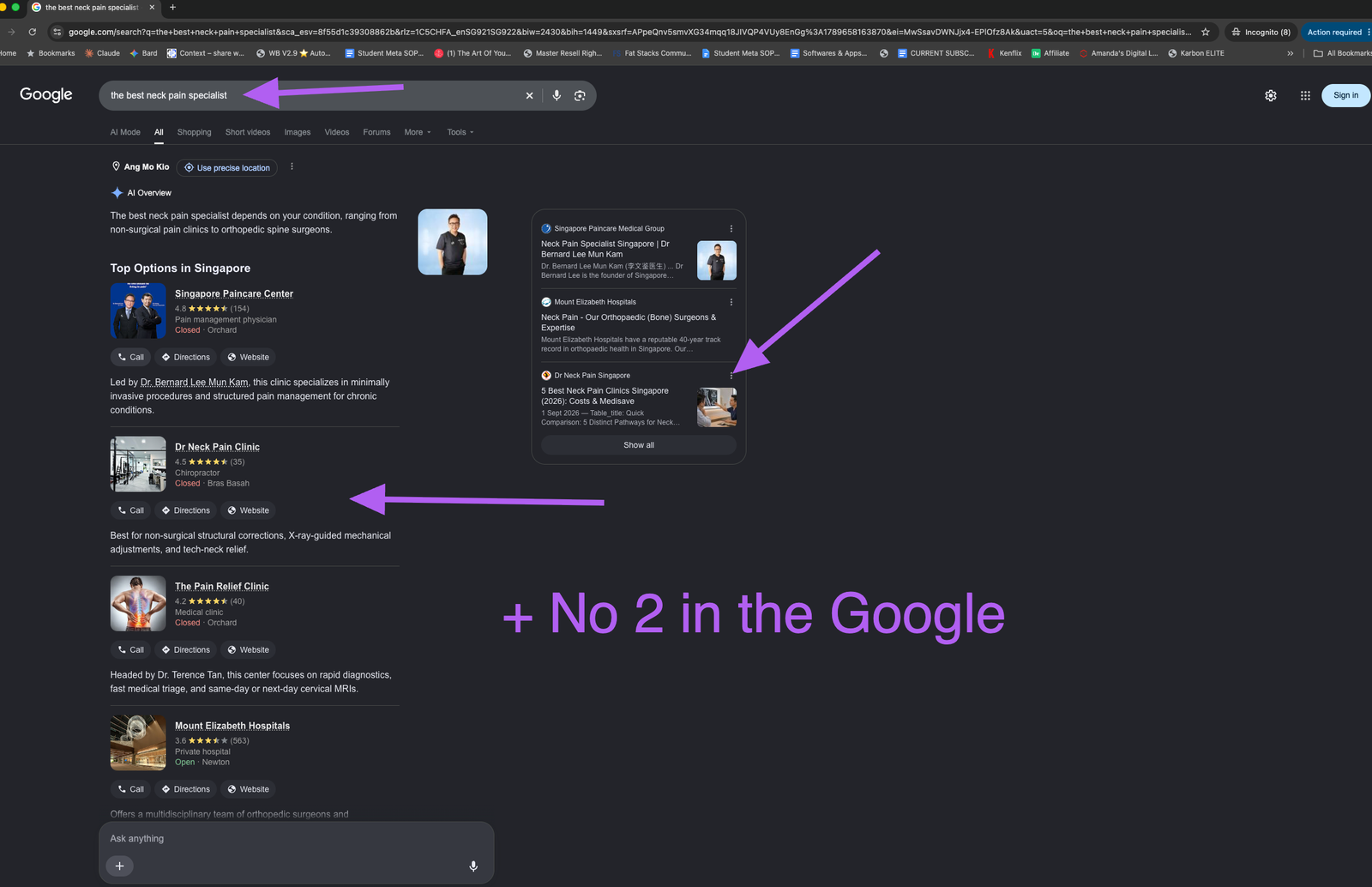
Screenshot 2. Google search, Singapore, private window, 17 September 2026. Purple arrows mark the clinic in the AI’s list and in the sources.
Small site, big answers
In Search Console, the new guides earned nearly one in three of all the times the site showed up in Google’s AI answers, but only about one in six of its normal search appearances. Page for page, they were about twice as good at getting into AI answers as at getting into normal results. And the site is small. Semrush gives it an Authority Score of 9 out of 100. Hospitals with far stronger websites sit below it.
Said plainly
Guides and comparisons earned their way into AI answers roughly twice as easily as into ordinary search results, on a site with no size or history behind it.
To be fair about it: these are Google’s AI answers, which we can check signed out with the date on screen. The ChatGPT figures in this post come from the studies listed at the end. AI answers change from day to day, which is why we check again every month.
Guides get you quoted. Comparisons, “best” and “how to choose” pages, and other people’s mentions get you named.
A business that only writes guides feeds the AI and gets forgotten. A business that only has a homepage gets skipped. You need the mix.
Try it on your own business
You can see where you stand in five minutes. Use short questions, the way your customers do.
Ask ChatGPT this yourself
Open a temporary chat, or log out first. A logged-in ChatGPT remembers you and can tilt the answer in your favour.
Best [your treatment] in [your area]?[Your treatment] or [the other option], which is better?How much is [your treatment] in Singapore?Is [your business name] any good?
Write down who gets named in each answer. If it’s a competitor three times out of four, you have your answer.
Why this is not a technical job
A lot of what is sold as “AI visibility” is a technical checklist: schema markup, an llms.txt file, a site audit. Look back at the data in this post. The things that moved AI answers were pages that answer real questions, reviews, and other sites talking about the business. None of them is a code fix.
The four steps for getting other sites to talk about you are in the step-by-step version, from one sentence to press. So keep your web person. They do useful work. Just don’t let a list of fixes stand in for the publishing.
Why most owners never get it done
By now you know what ChatGPT wants. Here is what it takes to give it that, every month.
- Find the questionsthe ones customers type into ChatGPT and Google about your treatments, in their words
- Write the comparisonsfair ones, that say when the other option is better
- Keep your service pages currentprices or what sets them, who it suits, the first visit, with a visible date
- Get written about elsewherearticles, videos, podcasts and news on sites that aren’t yours
- Look after reviews and listingsso the AI’s cross-check finds the same story
- Ask the AI againthe same questions, every month, and compare who it names
If that list made you tired, that’s the honest reaction. It is a second job. You already have one: looking after your clients.
And the answer doesn’t wait for you. Every month nothing new goes out about your business, ChatGPT keeps giving the names it gave last month. Some of the people asking were ready to book, and they never found out you were an option.
Two ways to get there
You can do this yourself or have it done for you. Both work. The difference is time and reach.
Write the pages, then keep going
Start with your service pages and one fair comparison. Add a page a week. Ask for reviews. It works, slowly, if you keep it up for months.
- Best for owners with time, or a writer on the team
- Where it stops it is still only your own site talking about you
We write it, publish it widely, and check the answers monthly
We start with the free AI Search Audit: we ask ChatGPT, Gemini, Perplexity and Google the questions your customers ask, and write down who they name. Then we build the pages that are missing. MultiCasting takes the same answers beyond your site as articles, videos, podcasts and slideshows, on places you already know: Google News, YouTube, Spotify, Apple Podcasts, LinkedIn, Medium and established news sites. Every month we ask again, so you see what changed yourself.
MultiCasting in one line: the one thing you want to be known for, turned into articles, videos, podcasts and slideshows and published in many places, every month.
- Best for clinics and salons that want to be the name AI gives
- Where it stops it won’t fix a weak offer or a front desk that misses messages
Not sure where your gaps are? Tick what’s true for you.
2-minute self-check
Is your content working for ChatGPT?
Tick any that sound like you. A result appears as soon as one is true.
Your result will show here.
Ticked one or more? The free audit shows which questions ChatGPT answers with a competitor’s name. Get My Free Audit ↗
A gap is opening
One or two missing pieces is enough for ChatGPT to name someone else on some questions. The free audit shows which questions, and who it names instead.
You are mostly being skipped
Three of four. ChatGPT has little about you to repeat, so it repeats your competitors. On a short call we look at your audit together and pick the pages to build first.
ChatGPT has nothing to go on
All four. That is fixable, and it is exactly what MultiCasting is for: the missing pages, written for you and published in many places every month. Start with the audit so we both know where you stand today.
Want to know who ChatGPT names instead of you? We ask the questions your customers ask and show you the answers.
Get My Free Audit ↗Questions owners ask
What kind of content does ChatGPT cite most?
“Best” lists, comparison pages, explainer articles and businesses’ own service and price pages. Which one it picks depends on the question. For a local business, the pages that get your name said are comparisons, “how to choose” guides, clear service pages and what other sites say about you.
My page is cited by ChatGPT. Why doesn’t it mention my business?
That’s a ghost citation, and it’s common. In one 2026 study, 61.7% of AI appearances linked a site without naming the brand. Explainer articles get quoted this way most. Comparison and service pages, plus mentions on other sites, are what get the name into the answer.
How often should I update my pages?
Whenever something real changes, and at least every few months for your key pages. In Seer Interactive’s 2026 study, 72% of pages AI cited had been updated in the past year. Show the updated date on the page.
I run a medical clinic. Can I still do this?
Yes, and you stay in control. What we publish is educational and factual: what a treatment is, who it suits and what to expect. No before-and-after photos, no “best clinic” claims, and no patient stories about results. You approve the topics before anything goes out, and your own compliance check always has the last word.
Do I need schema or an llms.txt file?
No. ChatGPT can read your site without them. Schema is quick to add and does no harm, so add it if your web person offers. What gets a business named is the right pages and other sites talking about you.
How long before ChatGPT starts naming me?
Nobody can promise a date, and nobody controls the answer. Google’s AI picked up one of our client’s pages within two hours. Other answers take months. That’s why we ask the same questions every month and compare, so you see the change instead of guessing.
Be the name ChatGPT gives.
A short call. We look at your audit together and pick the first pages to build.
Book a Call ↗References
- SOCi. 2026 Local Visibility Index. 28 January 2026. soci.ai
- BrightLocal, Rosie Murphy. Local Consumer Review Survey 2026. 11 February 2026. brightlocal.com
- BrightLocal, Sammy Paget. Uncovering ChatGPT search sources. 12 December 2024. brightlocal.com
- Singapore Economic Development Board. OpenAI establishes presence in Singapore. 9 October 2024. edb.gov.sg
- TechCrunch. ChatGPT reaches 900M weekly active users. 27 February 2026. techcrunch.com
- Semrush, Margarita Loktionova, with Kevin Indig. Why 62% of AI citations don’t lead to brand mentions. 9 June 2026. semrush.com
- Ahrefs, Glen Allsopp. Do self-promotional “best” lists boost ChatGPT visibility? 4 December 2025. ahrefs.com
- Wix Studio AI Search Lab. The content types most cited by LLMs. 23 March 2026. wix.com
- Yext. AI citations research. 9 October 2025. yext.com
- Discovered Labs, Liam Dunne. How ChatGPT retrieves in 2026. Updated 6 September 2026. discoveredlabs.com
- Ahrefs, Louise Linehan and Xibeijia Guan. An analysis of AI Overview brand visibility factors (75K brands). 26 May 2025. ahrefs.com
- Ahrefs, Louise Linehan and Xibeijia Guan. Top brand visibility factors in ChatGPT, AI Mode and AI Overviews. 12 December 2025. ahrefs.com
- NP Digital. Content types that perform best in AI search. May 2026. neilpatel.com
- Seer Interactive, Sonny Vasquez. Content recency’s impact on AI visibility in 2026. 24 July 2026. seerinteractive.com
- Singapore Statutes Online. Healthcare Services (Advertisement) Regulations 2021. sso.agc.gov.sg
- Ministry of Health. Regulation of advertisements for aesthetic treatments. 9 January 2024. moh.gov.sg
- Ministry of Health. FAQs on the Healthcare Services (Advertisement) Regulations, version 1.1, updated November 2024. moh.gov.sg (PDF)
Most studies cited here measured US or global data, not Singapore clinics, and each used its own method. Treat the figures as direction, not guarantees. AI tools change their sources without notice. Nothing in this post is legal advice on healthcare advertising.